Guard Rails, Not Guesswork: Avoiding Lethal Mutations in Teaching Playberry-Laser
In teaching, a lethal mutation is what happens when an evidence‑informed educational practice is altered or adapted to the point that the modification makes the strategy ineffective or even counterproductive. The term has its origins in scientific discussions, but in education it describes those moments when well‑intentioned teachers adjust proven approaches without fully understanding the underlying mechanisms, thereby compromising the intended benefits of the practice. If we are honest, most of us have lethally mutated something at some point.
Scripts, fidelity, and “too many words”
As I write this, I am learning a new program to use with some of my dyslexic students at Fullarton House. It is a highly explicit program, which means it includes a script. Not long ago, I would have been quite affronted if you had given me a program that not only told me what to teach, but also which words to use with students as I taught them. “How dare a program control what I say to students!” was very much my stance.
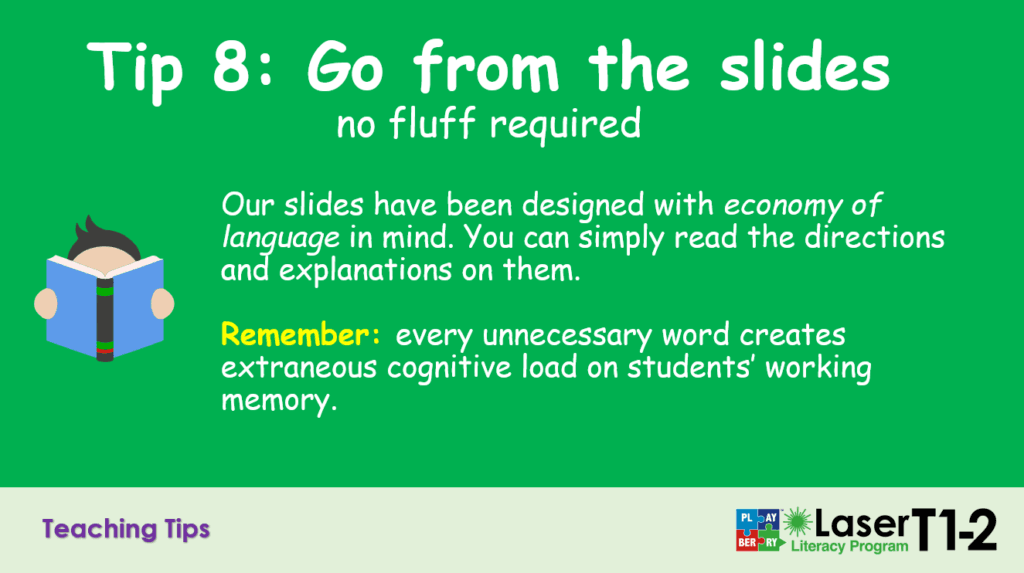
I now think differently. I am doing my best to stick to what this program says I should say, because the scripting guides me to direct students’ attention to exactly where I want them to look on the page. It tells me when to check for understanding and how to use language so that I keep it clear, without extraneous “fluffy” and unnecessary words. If you know me, you know how much of a challenge this is.
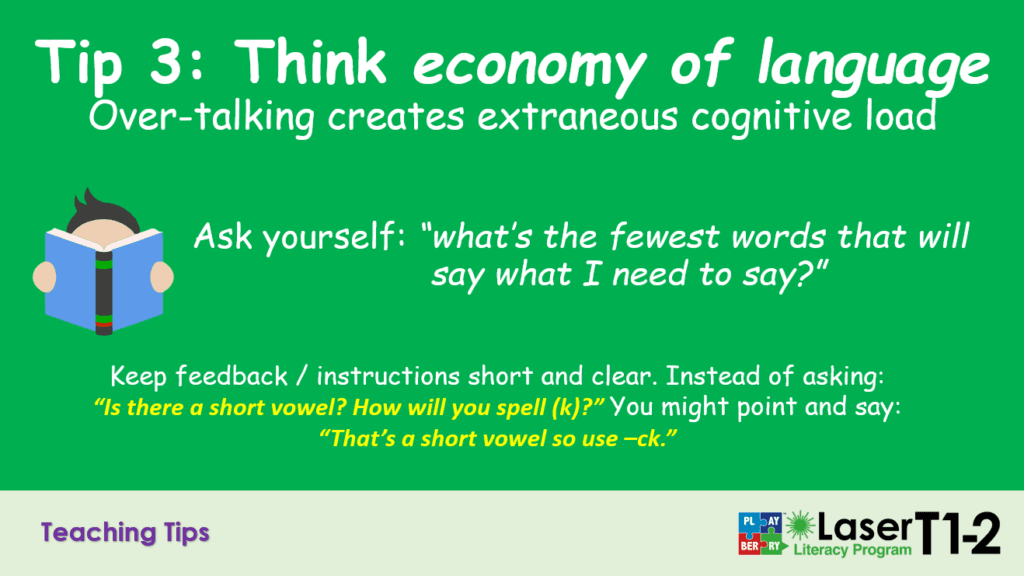
This business of using only strictly necessary words is often called “economy of language”, and it is really just a mechanism to make sure teachers do not drown students in a “sea of blah”. When you dig down, it is a cognitive load issue: one way we teachers create extraneous load is by talking too much. I am a terrible offender, but I am working on it.
With this program, I am learning that saying the right thing at the right time is essential, not a trivial detail. If I go off script (which I have done plenty of times), I confuse students. I am not new to what the program is teaching (structured literacy), but I still have to be disciplined and teach it with fidelity; otherwise, I diminish its effectiveness. That takes more self‑control than I would like to admit, and it has reminded me just how hard it is to stick to a program’s recommendations—to teach it in the way it was intended to be taught.
Teacher autonomy and professional “guard rails”
Teacher autonomy is a very big thing in education. We hold tightly to the idea that teachers are professionals who should have control over how we teach and, in some cases, what we teach. When teaching is compared to other professions, such as medicine or engineering, this idea of trained professionals being free to work “their way” becomes quite interesting.
If my GP finds I have high blood pressure, they have a clear set of guidelines for treatment—professional guard rails, if you like. If they stray too far from these guidelines, my health and their registration are in peril. Similarly, if a structural engineer is tasked with designing an overpass, they must operate within design guardrails based on proven principles from the physical sciences. If they go outside these guardrails, we get a dangerous structure.
Crucially, both doctors and engineers are also highly trained in the underlying “why” of what they do. If a doctor launches into treating hypertension without understanding cardiovascular physiology, or an engineer starts choosing steel and concrete without understanding their properties, lethal mutations in practice quickly creep in. Their professions acknowledge that freedom to act sits inside boundaries set by strong evidence and deep knowledge.
As a profession, I think teachers are only just beginning to come to terms with the fact that our practice must be constrained by what educational research says are “best bets” for achieving the greatest outcomes for most students. We are also only just beginning to realise that what many people call “research” is, at best, anecdote dressed up as evidence, and that some of the worst offenders can be found in teacher training institutions and parts of education academia. We’re all having to become more research literate.
Playberry Laser and minimising lethal mutations
When we started Playberry Laser, we wanted to minimise the harm to learning caused by untrained but well‑meaning teachers. We knew that many people picking up our program would already have a strong knowledge base in structured literacy, and many would be brand new to it. That mix created both an opportunity and a risk.
To manage this, we decided that our Nuts and Bolts training would be mandatory for any new teacher teaching with Playberry Laser. We also took a firm line with schools and said, “Use DIBELS or find another program.” These are hard positions to adopt when you are a new program in an ecosystem full of well‑established alternatives that claim to do what you do, but place far fewer demands on schools.
We stuck to our guns. Those requirements —explicit training, clear assessment expectations, and an insistence on fidelity—were our way of building guardrails to prevent lethal mutations in practice. Now, some years on, we think we are seeing the results of placing these expectations on schools: more consistent implementation, fewer well‑meaning but damaging tweaks, and better outcomes for students.
Lethal mutations will always be a risk when complex practices meet busy classrooms and human judgment. Our task, as a profession, is not to eliminate professional autonomy, but to understand where the evidence‑based guardrails are, and to respect them enough not to quietly remove them in the name of “doing it our way”.
How do we get our teaching of Playberry Laser right and minimise lethal mutations?

Use the Teacher Manual
Our compulsory Nuts and bolts training is only just a start – the tip of the iceberg. Our highest-performing schools consistently refer to the teacher manual, which is available in the ‘how to’ section of the website. These schools build mini in-house staff trainings around each component of the Playberry laser lesson, using the manual as a resource.
Watch the demonstration lessons and read the masterclass notes
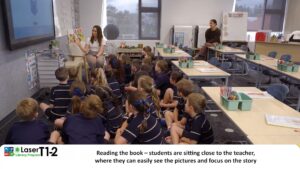
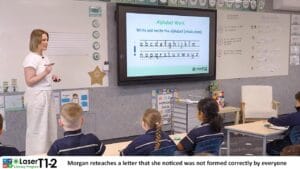
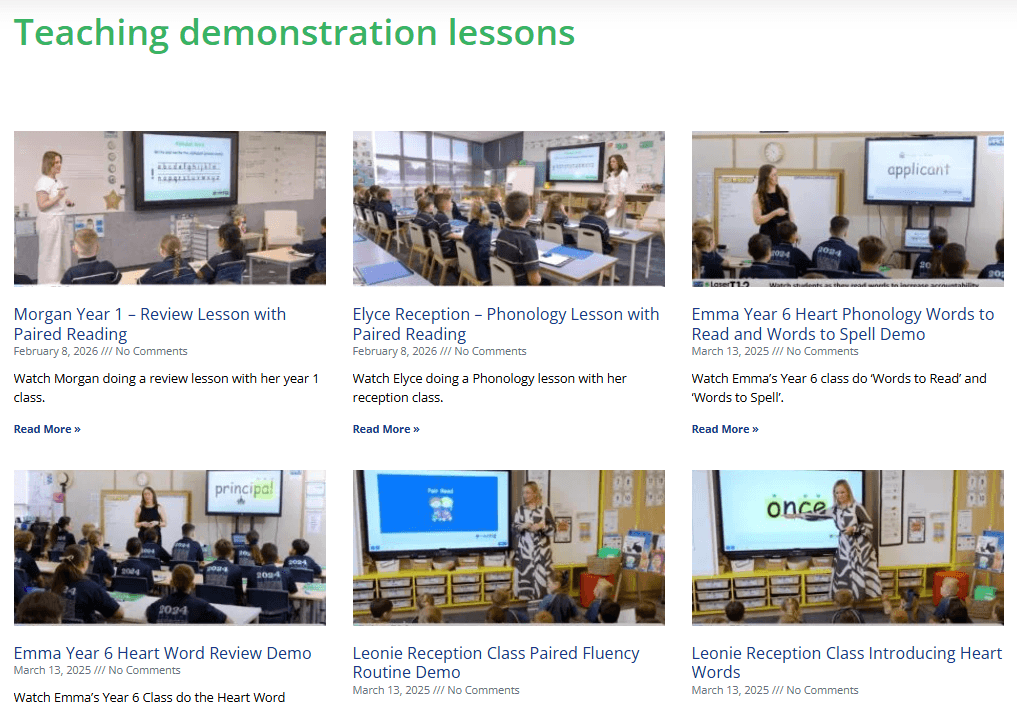
Our growing library of demonstration videos of real-time teaching is an amazing resource. Many of these have masterclass notes that pull together what you see in the videos into their granular parts, so you can see the mechanisms at work. Many schools have built staff training sessions around parts of these videos. These are exemplars of Playberry Laser lessons.
Book live demonstration lessons and observations
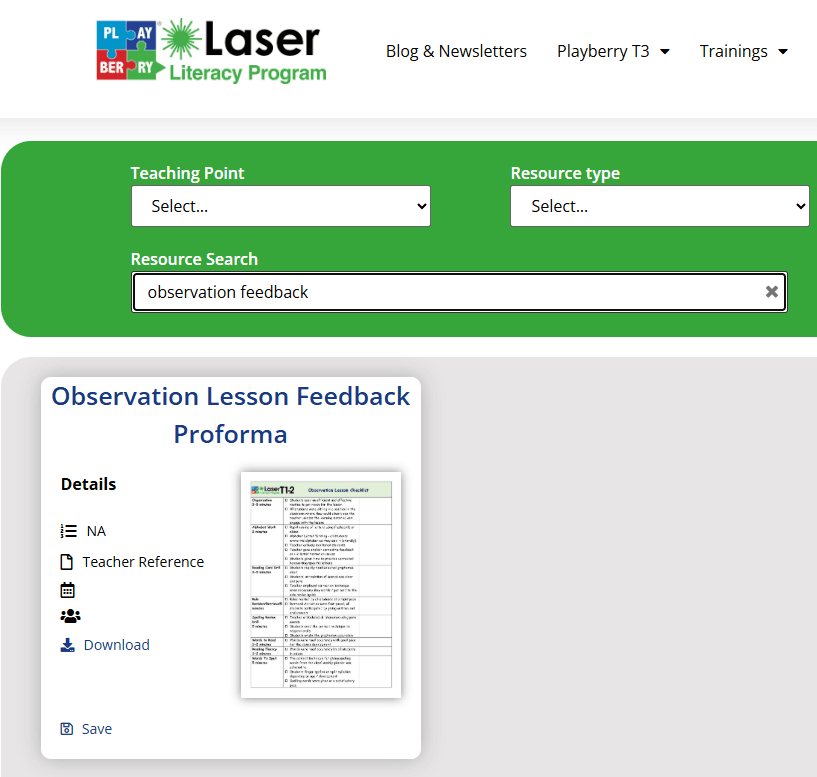
The schools that get the teaching the tightest, the fastest get us in within a few weeks (or months) of starting the program to teach classes whilst teachers observe. This clears up many lethal mutations early and sets teachers up for success. A few months later, we’re invited back to observe teachers in action. When we do this, we are accompanied by the school’s key literacy teacher (or whoever is doing the instructional coaching) so they can see us at work during coaching conversations. Our goal is to set up schools for in-house instructional coaching cycles so everyone’s practice continues to improve. We’re currently exploring Steplab to sharpen our instructional coaching model, so watch this space.
Check out the Blog Posts, Newsletters and ‘How To’ articles
In addition to our newsletters, we have a substantial back catalogue of articles, reflections, and practical ideas designed to help you keep improving your teaching, no matter where you are on your journey.
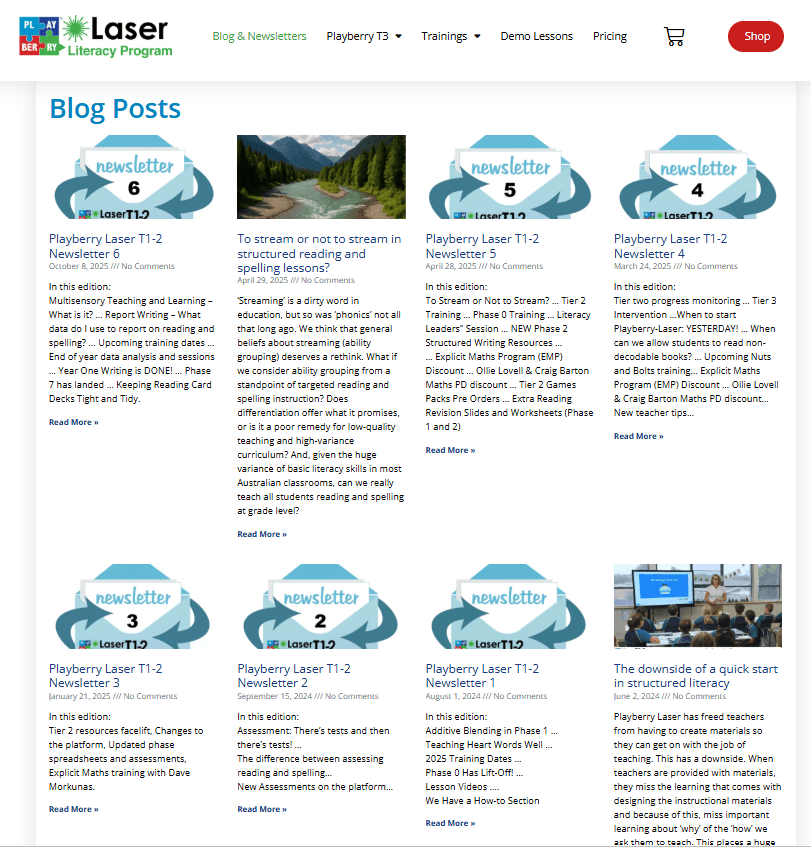
We’re not only interested in high-quality literacy instruction but also in all corners of learning science, from what happens in working memory to the nuts and bolts of classroom routines. We regularly explore how theory connects to the reality of the students in front of you, so you can see what research looks like in action. We’ve written posts on a wide range of topics, including Rosenshine’s Principles of Instruction, Streaming and grouping, and getting really clear on pure sounds (phonemes), along with other everyday questions that come up in real classrooms, such as how to maintain momentum in lessons and how to support your most vulnerable learners without holding anyone else back.
Ratcheting up the Retrieval Effort During Review
Research on desirable difficulties shows that making retrieval effortful can strengthen learning. Björk and colleagues distinguish between storage strength and retrieval strength, arguing that difficult but successful retrieval boosts long-term storage more than easy review. One of these desirable difficulties is ‘varying the conditions of practice’. Learning something in the same way (under constrained, predictable conditions) can lead to contextualised learning that does not support later performance.
These findings have led us to reconsider our definition and rule retrieval slides. We don’t want you to limit retrieval opportunities to only what the slides tell us to do. We want you to start to ratchet the retrieval effort on the occasional slide when you can.
Now, doing this during review risks blowing out the time it takes to complete this part of the lesson (which is designed to be quick-fire), so be careful to choose fast ways to get students applying their knowledge.
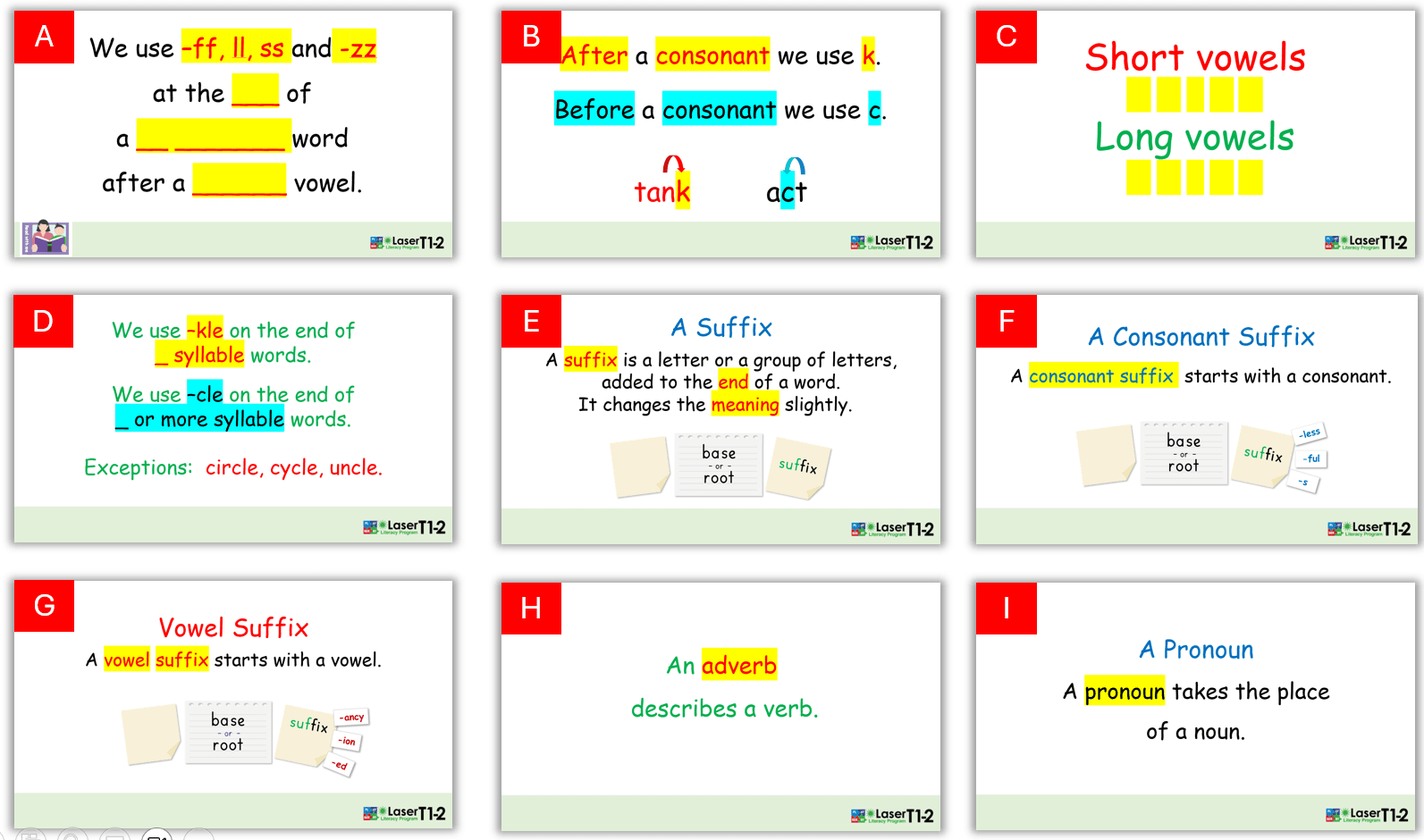
On the right are some ideas for the slides you might try.
Slide A: Students write a non-word on their whiteboards using the spelling rule and then chin it. Responses might be ‘ploff’ or ‘smezz’.
Slide B: Students deliberately misspell ‘tank’ or ‘act’ (or any other word) on their whiteboards by using a spelling of (k) that deliberately breaks the rule.
Slide C: Students write a word with a short/long vowel and chin it.
Slide D: Write ‘barnakle’ (or another deliberately misspelt word) on the board – A’s tell B’s why it’s misspelt.
Slide E: Write ‘redo’, ‘doing’ and ‘wash’ on the board, and students write the word with the suffix and chin it.
Slide F: Write ‘helpful’, ‘kindness’ and ‘helped’ on the board: students write the word(s) with the consonant suffix on their boards and chin it.
Slide G: Write ‘helpful’, ‘kindness’, and ‘helped’ on the board. Students write the word(s) with the vowel suffix on their boards and chin it.
Slide H: Students turn the verbs ‘quick’ and helpless’ into adverbs and chin it.
Slide I: Students list as many pronouns as they can in 10 seconds, then chin it
Getting your Sounds Pure - No Schwabecues
Pure sounds are crucial to forming accurate mental representations of speech sounds (phonemes). Most of us have taught from programs that are a little sloppy on phoneme pronunciation and have formed not-so-great pronunciations. The video on the left covers some of the trickier phonemes and their pronunciations in Playberry Laser T1-2. Some schools use this video in staff meetings to get sounds pure and have a good laugh at each other! Some teachers show this to students, and some even send it home to parents.
Word Rap has arrived to Phase 1
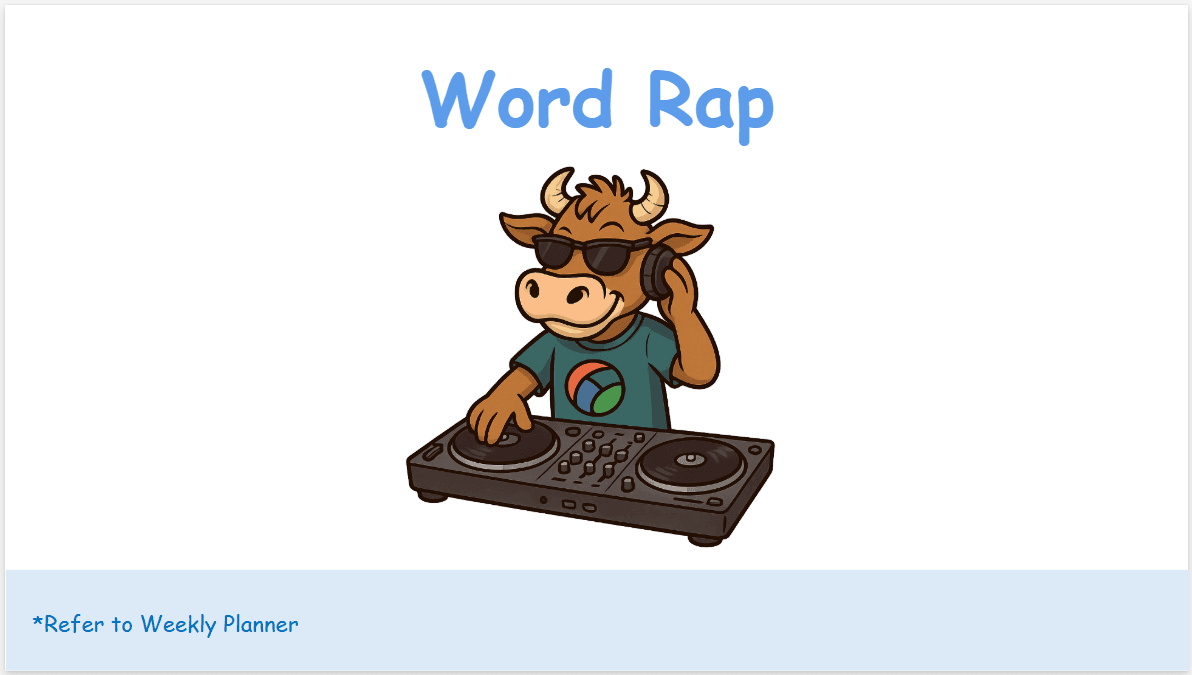
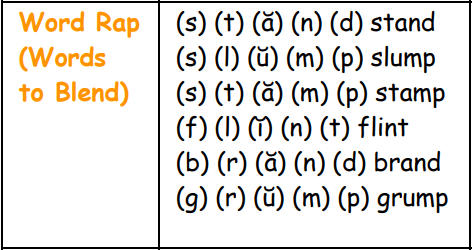
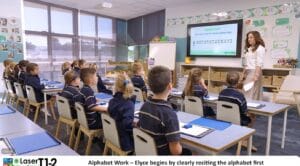
In Phase 1, we’ve added a new routine for practising phoneme blending, an essential phonemic awareness skill. We call it ‘Word Rap’. Word Rap is in 2026 slides (look out for DJ Cow), and weekly planners and it slots in between ‘Words to Spell’ (review) and the new teaching point. It’s a straightforward choral routine, and we think the kids will love it. Watch the video above of Elyse and her students from Star of the Sea School doing a Word Rap!
We've made corrections to the Phase 1 Weekly planners so please reprint them or the Word Rap notes will be WRONG!
New Demo Lessons are up!
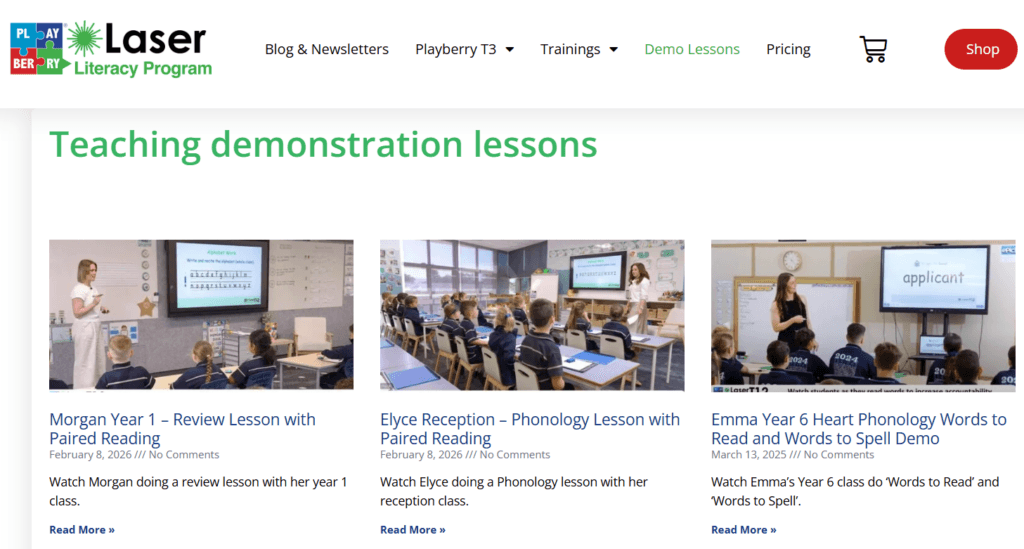
At the end of 2025, we were in classrooms at Star of the Sea School in South Australia, filming some great teaching and learning.
Demonstration lessons are a great way to check out how experienced teachers run tight teaching routines. Each video is a treasure trove of techniques that can be dissected and used during in-house professional development sessions. Masterclass notes accompany some lesson videos and provide guidance on where to look while watching lessons.
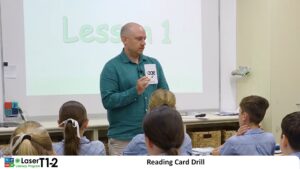
Take-home Phase 1 Student Card Decks
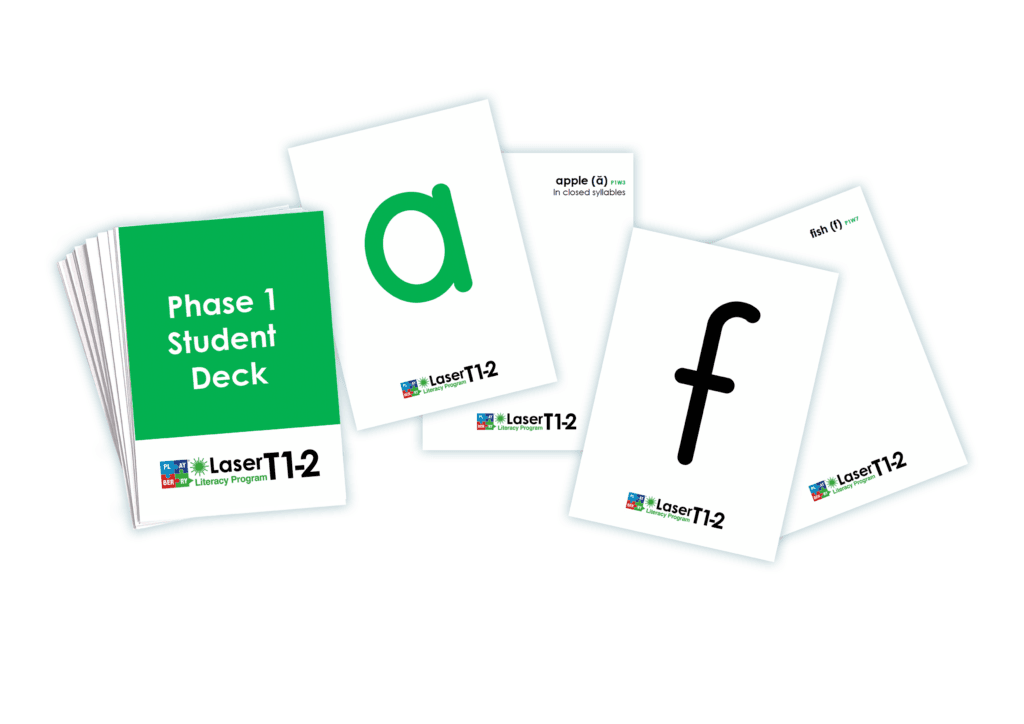
Every class has students who need more practice with the reading card deck. We have a solution. This card deck is for individual student practice of the grapheme phoneme correspondences already taught.
Class set of 25 decks $125+GST
Individual deck $6+GST
The Phase 1 Student Card Deck includes the grapheme-phoneme correspondences taught in the Playberry Laser Phase 1 Scope and Sequence.
The cards are 5 x 7 cm and robust, so they will last a long time if treated well!
Heart words have had a facelift
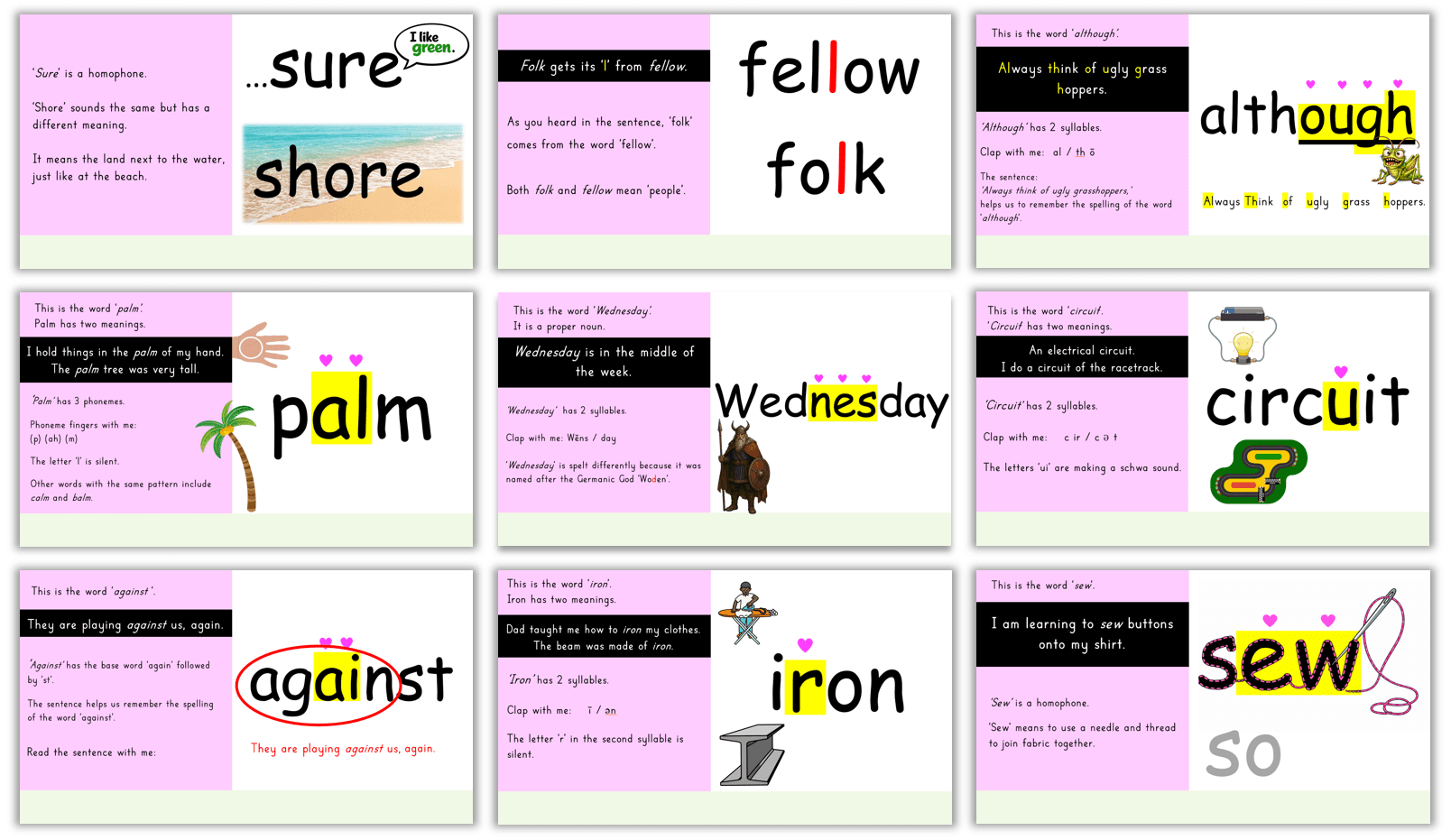
There are several ways to learn the irregular spellings in heart words. Sometimes it’s easiest to learn the letter order through the arm-tapping or syllable-tapping routine alone. But, with other words, we could use spelling voice, the word’s history (etymology), its word family, a mnemonic or its morphology to create a memory hook for students to make its spelling more memorable. In 2026, we’ve dived in and set up the slides to teach heart words using one of these strategies, which we call ‘glasses’.
The video below is a draft (not perfect – some glitches), but we wanted to give you a sneak peek at our online nuts-and-bolts training currently in the works, which delves into Heart Words, and the rationale for the teaching changes from 2026.
Upcoming Tier 3 Trainings

The Playberry (Playford & Hansberry) T3 Multisensory Literacy Program is a tier 3, intensive intervention for students with severe reading and spelling difficulties.
Playberry T3 is the intervention program of choice for schools using Playberry Laser T1-2. Playberry T3 is used by specialist intervention teachers, speech and language pathologists and specialist tutors who have trained in the TSD courses (Teaching Students with Dyslexia levels 1-3).
Upcoming Tier 2 Training
The Playberry Laser Tier 2 training day is for teachers and support staff who teach intervention groups using the Playberry Laser Tier 2 resources. Participants will learn how to deliver Tier 2 Intervention Lessons, assess progress, and access resources. The day also includes observing a demonstration lesson with students.
Participants must bring a mini whiteboard and a whiteboard marker.
23rd March 2026
Star of the Sea School, Henley Beach, SA
Morning tea provided. BYO Lunch.
9:00 am – 2:45 pm.
Remember, training information will only go the person who made the booking.
Reception, Year 1 and 2 Explicit Writing is ready!
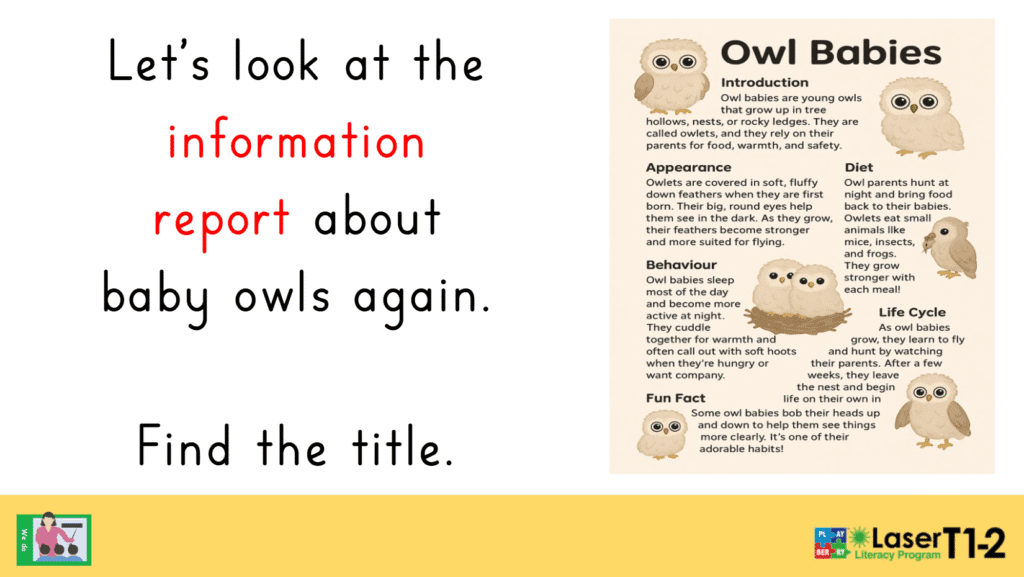
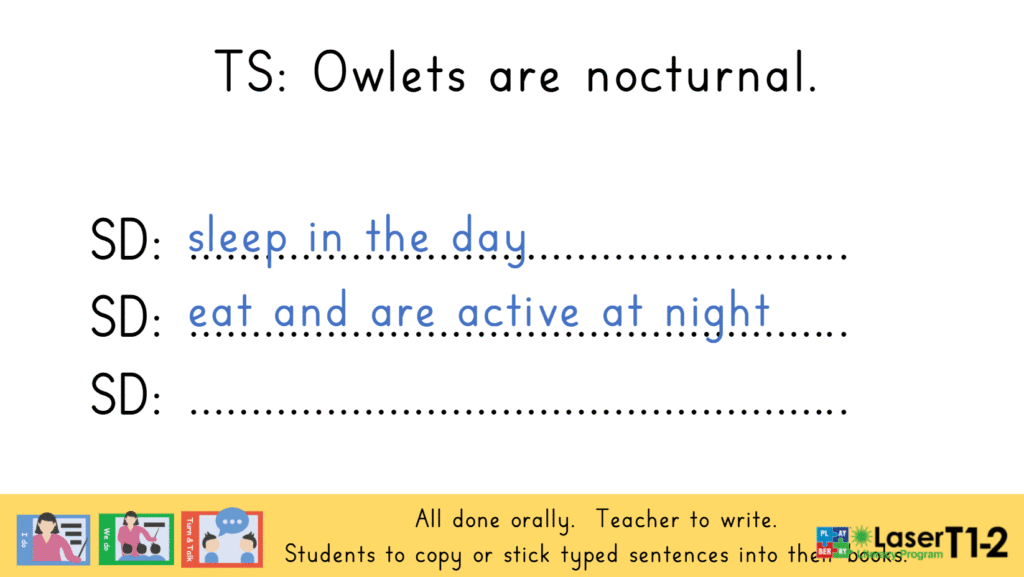
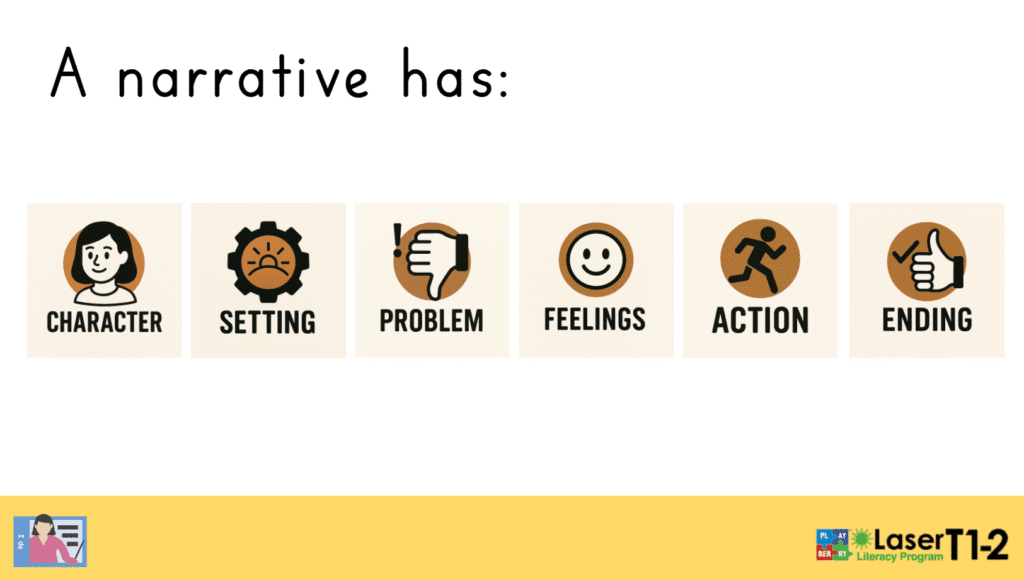
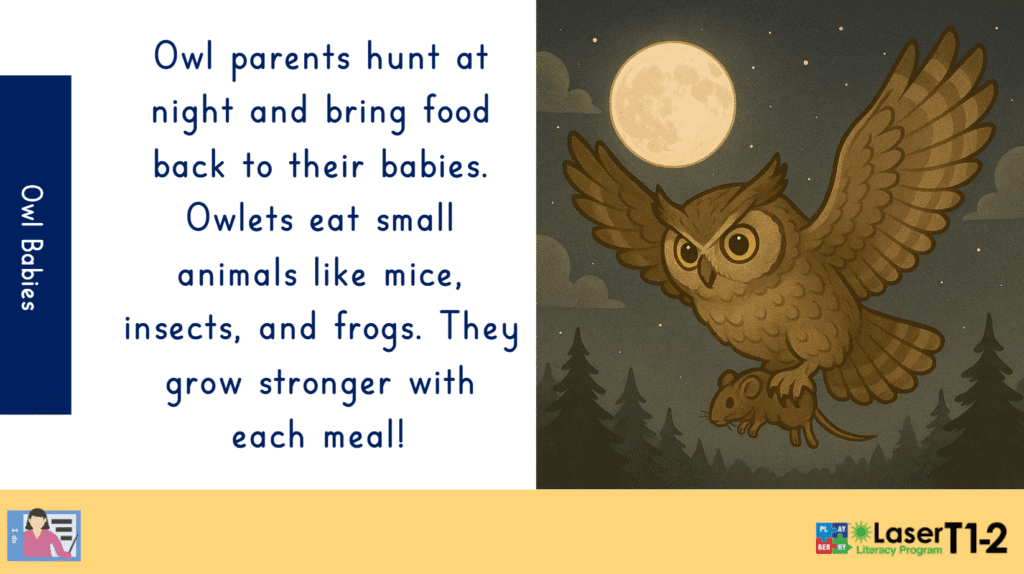
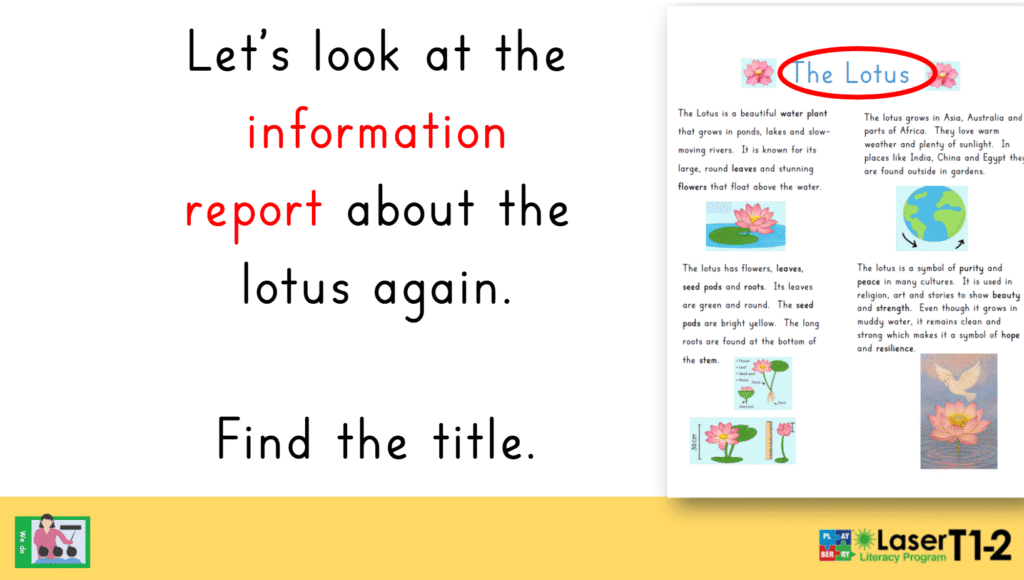
Explicit Reception, Year 1 and 2 structured writing lessons are now available on our platform. We believe we have found the ideal balance with our explicit, fine-grained writing instruction. We’ve drawn inspiration from a diverse selection of beloved texts and chosen from the best explicit writing pedagogies.
Each lesson is meticulously designed to combine the best features of explicit and direct teaching in structured writing. Teachers and students familiar with Playberry-Laser programs will appreciate the familiar frameworks and instructional routines integrated into the lessons.
Changed Captains? Let Us Know.
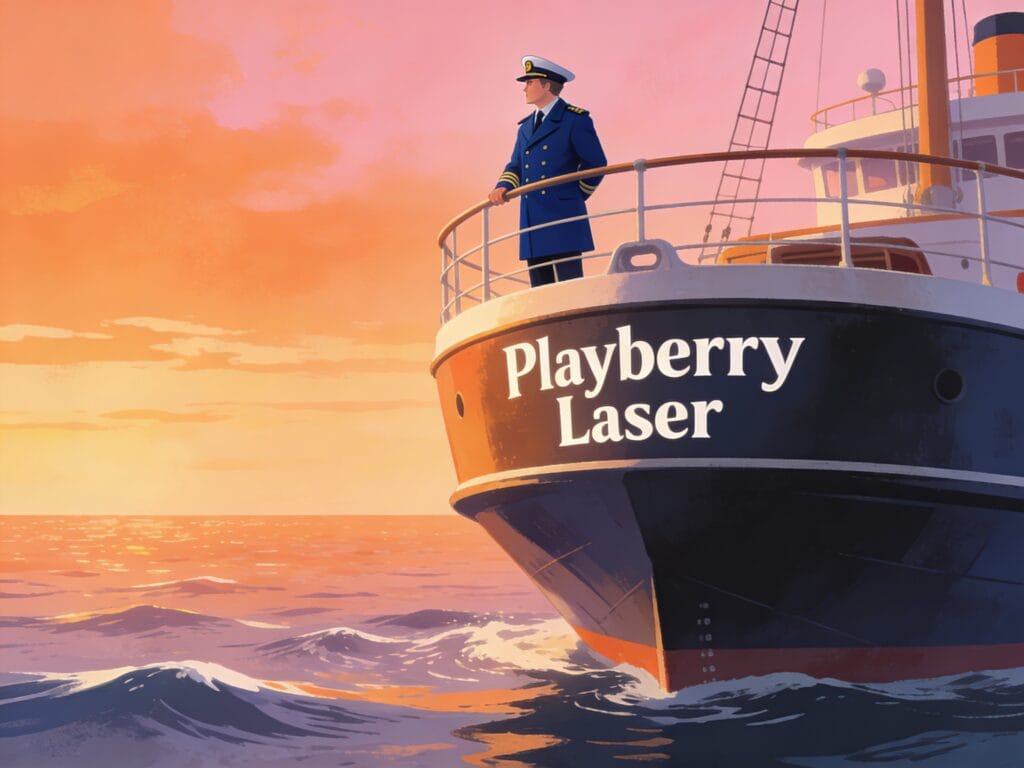
Each school has one designated person (we call them the captain) who controls member access to the Playberry Laser website. Without access, you can’t access the lessons. Unfortunately, there can be only one captain per school.
Whenever a new teacher starts or a teacher leaves, the captain needs to add or delete the sub accounts. It’s important to monitor who has sub-accounts so you don’t accidentally exceed your allocated number.
Equally important is making sure that if the captain leaves the school, you reach out to us to let us know who is taking over the captaincy; otherwise, things get messy!