

By Jared Centenera:Dean of Staff DevelopmentSaint Ignatius' College South Australia
Over several years of implementing Playberry Laser, we have seen excellent outcomes across the school, particularly in phonics instruction and diagnostic data. That strong foundation has given us the confidence and the headroom to ask a more ambitious instructional question: not just, “Is Playberry working?” but, “How do we get the very most out of it?”
Part of what makes Playberry Laser so effective is the fluency it builds. Because students encounter its routines consistently across multiple year levels- choral response, whiteboard routines, retrieval activities, rule revision- they become highly practised in the structure of the lesson, which frees up cognitive space for the content itself. As that fluency has matured across the school, it has opened up an exciting next layer of practice for us to develop alongside it:
How do we make sure students are thinking as hard as possible about the content they’re retrieving?
Our emerging focus is on being increasingly deliberate about driving student thought around the retrieval and application of spelling rules, phoneme–grapheme correspondences and previously taught knowledge, using Playberry’s structure as the platform for that work.
In particular, we’re interested in strengthening the transfer of what students demonstrate in structured literacy lessons to what they can independently retrieve and apply outside the lesson. We already see very high levels of success during the lessons: the routine, the carefully sequenced content, teacher modelling and gradual release of responsibility give students an exceptionally strong scaffold. Our aim now is to build on that scaffold so success within the lesson converts just as reliably into independent application in reading, spelling and writing beyond it.
This has led us to focus increasingly on the concept of driving thought.
Dan Willingham’s work in Why Don’t Students Like School? has been particularly influential here. At its simplest, the principle is that memory is shaped by what students think about. Students don’t remember something simply because it appeared on a slide, because a teacher explained it clearly, they giggled at it, or because they completed an activity; what matters is the thinking the task actually caused them to do. Playberry Laser’s explicit, sequenced design already puts the right content in front of students at the right time; our job is to make sure every student is doing rich thinking with it.
Consequently, the question we ask ourselves is evolving. It is becoming less:
“Was the lesson engaging, and were students participating?”
and increasingly:
“What, specifically, were students required to think about — and how deeply were they required to think about it?”

This distinction has also shaped our broader instructional coaching work, where we’ve been discussing with teachers that attention and thought are related but not the same thing. A teacher can secure 100% attention while students’ thinking remains relatively shallow -passive listening, copying, predictable choral responses, and repeated low-demand questioning can all produce a highly orderly classroom without requiring every student to retrieve, discriminate, explain, or apply knowledge. For this reason, we’re cautious about treating visible attention or compliance as a proxy for cognitive engagement.
The Playberry Laser scope and sequence provides a strong foundation and does the heavy lifting to ensure the right content is taught in the right order, explicitly and consistently. Our job as teachers is to bring the same intentionality to how students engage with that content, moment to moment, staying responsive to the group of students in front of us and using our judgement about when to add an extra layer of retrieval demand on top of Playberry Laser’s strong base.
Our current work has focused on two complementary approaches.
Approach One: Driving Thought in Playberry Laser lessons
The lesson content and design remain exactly as they are, but teachers have been working on making small, deliberate variations in instructional delivery when they judge that students are ready for greater cognitive demand.
Rather than moving straight into a familiar choral response, for example, a teacher might build in think time before asking students to retrieve a spelling rule. At other times, we might use:
- cold call
- think–pair–share
- everybody writes
- think–pair–write
- individual whiteboard retrieval before discussion
- planned wait time before applying a rule
- short explanations requiring students to justify which rule applies and why
These are small adjustments that vary the retrieval context while maintaining a sense of pace. The knowledge being retrieved stays exactly as Playberry Laser sequences it; what changes is the thinking students must do to access it.
It’s worth noting that Playberry Laser itself is already moving in this direction. Some retrieval activities increasingly vary how students encounter previously taught knowledge to keep them actively retrieving rather than pattern-matching within a familiar format. Our classroom-level adjustments are designed to work in the same spirit, extending that same principle further into daily practice.
Approach Two: Driving thought beyond the Playberry Laser Lesson
If a spelling rule, phoneme–grapheme correspondence or piece of knowledge has been explicitly retrieved within the lesson, how can we give students another opportunity to think about and apply that same knowledge in a slightly different context, so it truly sticks?
This doesn’t require an additional lesson. In many cases, it happens immediately after explicit instruction, through activities already connected to the program sequence. For example, teachers use Read and Grab (downloadable from Tier 2 resources) activities to give students more independent retrieval practice with knowledge just revisited as a class. From the connected texts, we generate independent retrieval tasks in which students identify or explain a specific spelling concept or phoneme–grapheme correspondences, and create word banks. Some teachers have also developed short retrieval tasks that ask students to independently generate examples, discriminate between possible rules, explain why a rule applies, or locate examples of the target knowledge in their own reading or writing.
The important shift is in context. Students move from applying knowledge:
Within Playberry Laser’s highly structured routines → with teacher direction and collective responses → towards increasingly independent retrieval and application.
We see this as the natural next step from the foundation Playberry Laser provides, a bridge between successful performance during explicit instruction and genuine transfer into reading and writing.
The Role of Instructional Coaching
Our instructional coaching work through Steplab has been particularly useful in supporting this development.
For classes that are already highly successful with the lesson routine, coaching offers a chance to look for the next opportunity to extend that success, to find moments when we could ask a little more of students’ thinking without changing anything about the program itself. A coach can help a teacher spot these moments and make small, high-leverage adjustments.
The coaching conversation gets very specific:
- What do we want students thinking about here?
- Who is doing the thinking?
- Does every student need to retrieve the answer, or can some rely on the group’s response?
- Could we vary the response mode without changing the content?
- What’s the next opportunity to extend independent retrieval a little further?
- How could we check that students can retrieve and apply this knowledge independently, beyond the lesson?
This is where we see a particularly powerful intersection between Playberry Laser and instructional coaching. Playberry Laser provides the curricular architecture and explicit instructional sequence; coaching helps teachers get even more out of it by staying responsive to the cognitive demands placed on the students in front of them.
Ultimately, this work is not about adding activities or moving away from fidelity of the scope and sequence, quite the opposite. It’s about using its strength as a platform to deliver increasingly precise teaching and to get the fullest possible return from a solid program.
As implementation matures, our question is becoming: how do we retain the consistency, pace and explicitness that make it work while continuing to sharpen the thinking students do within it?
Our approach is to continually monitor the relationship among attention, participation, and thought, and to use that insight to further extend Playberry Laser’s impact by varying the context, increasing retrieval demand, creating opportunities for independent application, and verifying that knowledge transfers.
The aim is not simply for students to become excellent at participating in a lesson. The aim is for the knowledge the scope and sequence contains to become increasingly retrievable, flexible and usable wherever students need it.
Here's an article from Newsletter 7 on the benefits of making students think harder during retrieval practice.
Ratcheting up the Retrieval Effort During Review
Research on desirable difficulties shows that making retrieval effortful can strengthen learning. Björk and colleagues distinguish between storage strength and retrieval strength, arguing that difficult but successful retrieval boosts long-term storage more than easy review. One of these desirable difficulties is ‘varying the conditions of practice’. Learning something in the same way (under constrained, predictable conditions) can lead to contextualised learning that does not support later performance.
These findings have led us to reconsider our definition and rule retrieval slides. We don’t want you to limit retrieval opportunities to only what the slides tell us to do. We want you to start to ratchet the retrieval effort on the occasional slide when you can.
Now, doing this during review risks blowing out the time it takes to complete this part of the lesson (which is designed to be quick-fire), so be careful to choose fast ways to get students applying their knowledge.
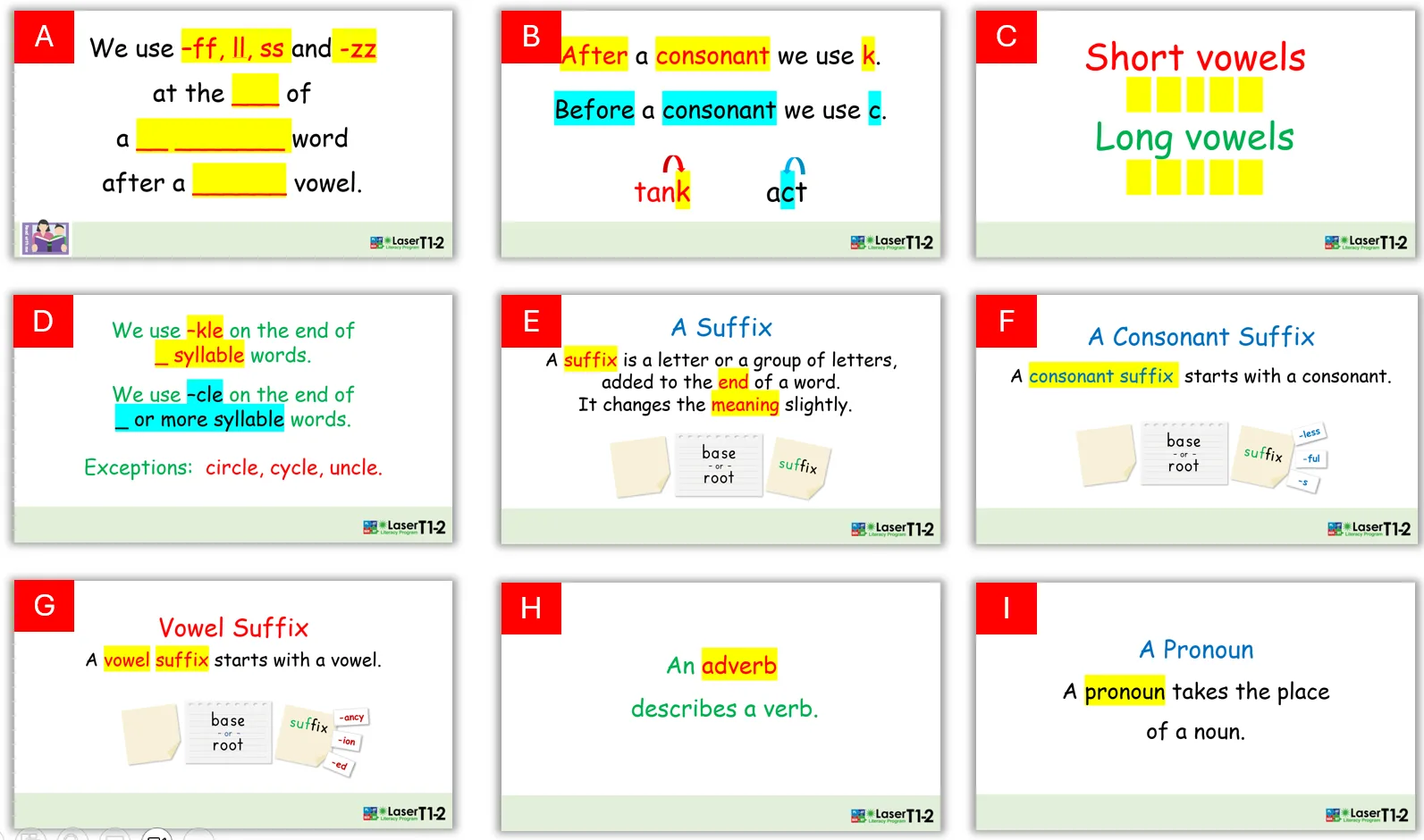
On the right are some ideas for the slides you might try.
Slide A: Students write a non-word on their whiteboards using the spelling rule and then chin it. Responses might be ‘ploff’ or ‘smezz’.
Slide B: Students deliberately misspell ‘tank’ or ‘act’ (or any other word) on their whiteboards by using a spelling of (k) that deliberately breaks the rule.
Slide C: Students write a word with a short/long vowel and chin it.
Slide D: Write ‘barnakle’ (or another deliberately misspelt word) on the board – A’s tell B’s why it’s misspelt.
Slide E: Write ‘redo’, ‘doing’ and ‘wash’ on the board, and students write the word with the suffix and chin it.
Slide F: Write ‘helpful’, ‘kindness’ and ‘helped’ on the board: students write the word(s) with the consonant suffix on their boards and chin it.
Slide G: Write ‘helpful’, ‘kindness’, and ‘helped’ on the board. Students write the word(s) with the vowel suffix on their boards and chin it.
Slide H: Students turn the verbs ‘quick’ and helpless’ into adverbs and chin it.
Slide I: Students list as many pronouns as they can in 10 seconds, then chin it